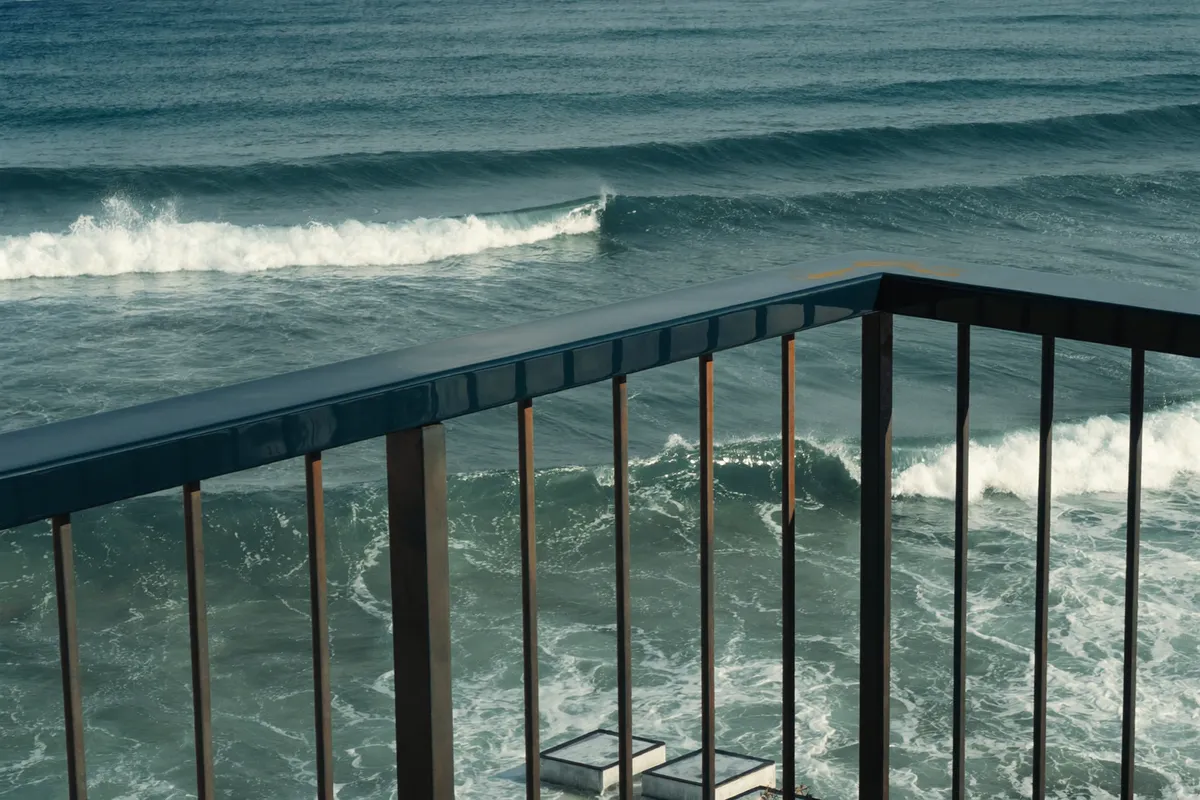
There is a 500-metre strip along Bali's coastline where standard painting simply does not survive. Beachfront villas in Canggu, cliff-top builds in Uluwatu, promenade properties in Sanur — I have seen ordinary enamel fail there in under six months, every time, regardless of how well it was applied. Salt crystals are hygroscopic: they sit on the coating, pull moisture from the air and keep metal wet around the clock. The only honest answer in that zone is a marine specification — the same epoxy-polyurethane stack used on harbour railings and boat fittings.
What Makes a Coating Marine-Grade
Epoxy Barrier Coats
Two coats of high-solids epoxy form a dense, salt-impermeable barrier 200+ microns thick — roughly triple the film build of a standard repaint.
Polyurethane Topcoat
Epoxy chalks in UV, so the finish coat is an aliphatic polyurethane: glossy or satin, UV-stable, and cleanable of salt film with plain water.
Surface Salts Removal
Before any primer, surfaces are fresh-water washed and tested for chloride contamination. Painting over invisible salt is the number one cause of coastal coating failure.
Stainless & Aluminium Care
Tea-stained stainless and pitting aluminium get their own treatment — passivation and clear-coat systems rather than paint where the look matters.
Where the Marine System Is Worth the Extra Cost
Marine-grade work costs 30–40% more than our standard three-layer system — the materials are imported and the prep is stricter. Within 500 m of the surf it pays for itself in the first year, because a standard system there lasts 12–18 months while the marine stack runs 3–4 years with simple maintenance. Past roughly a kilometre inland, standard protective coating is the smarter spend — we will tell you which side of that line your property sits on, for free.
Typical marine-grade projects: beachfront villa gates and fences in Canggu and Berawa, cliff-edge railings in Uluwatu, rooftop bar structures in Seminyak, and pool-deck balustrades that take both salt air and chlorine splash. We also maintain what we install — most beachfront clients move onto an annual maintenance plan after the first project.
How It Works
Exposure assessment
Send your location pin and photos. Distance to surf, wind exposure and metal condition decide the system — we confirm whether you actually need marine grade.
Chloride-clean preparation
Fresh-water washing, rust removal to bare metal, salt testing before primer. No shortcuts — this step is the guarantee.
Three-coat marine stack
Epoxy primer, epoxy build coat, polyurethane finish. 250–300 microns total, applied in correct overcoat windows.
Wash-down schedule
We hand over with a simple fresh-water rinse schedule that doubles the life of the system, plus the 12-month guarantee.
What It Costs
Marine-grade systems price at +30–40% over standard rates: a beachfront gate from IDR 2,000,000, railings from IDR 350,000/m, structures from IDR 130,000/m². Materials are imported epoxy and polyurethane — we show you the tins, not just the invoice. Compare with standard rates on the pricing page.
Good to Know
How much more does marine-grade coating cost?
Do I really need it, or is standard coating enough?
How long does a marine system last in Bali?
Can you apply it over existing paint?
Which areas do you cover for beachfront work?
Anti-Corrosion Coverage in South Bali
Beachfront Metal Needs Beachfront Coating
Send a location pin and photos — we will confirm whether marine grade is worth it for your property, free and honest.
Get a Beachfront Assessment